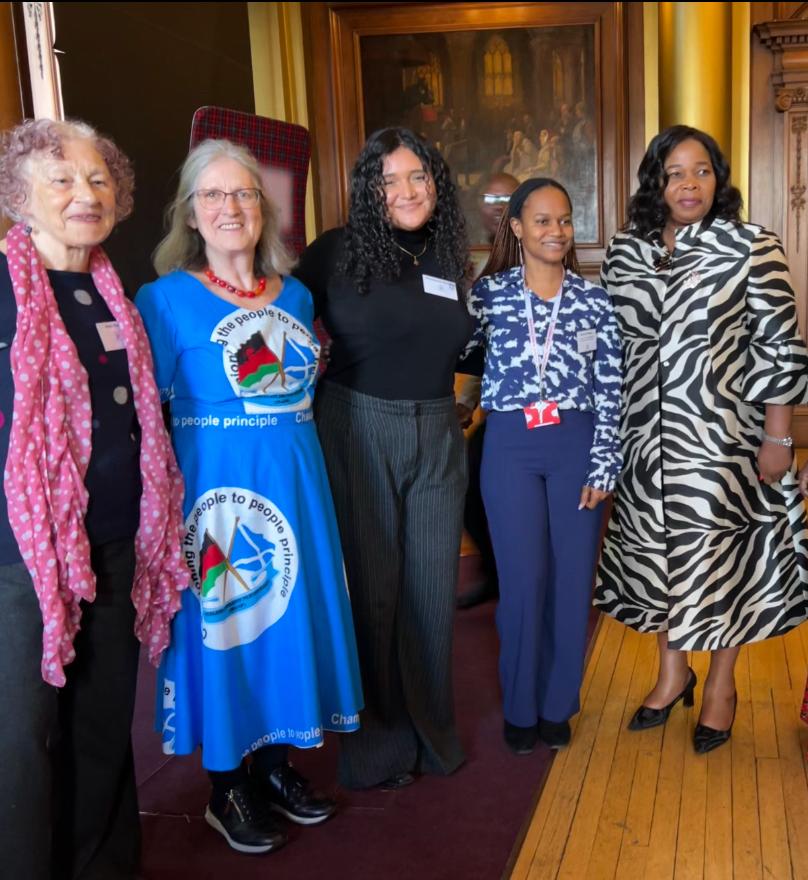
In the week of International Women’s Day 2026 we were honoured to meet the Malawian Minister for Gender, Children, Disability & Social Welfare, the Hon Mary Navicha MP.
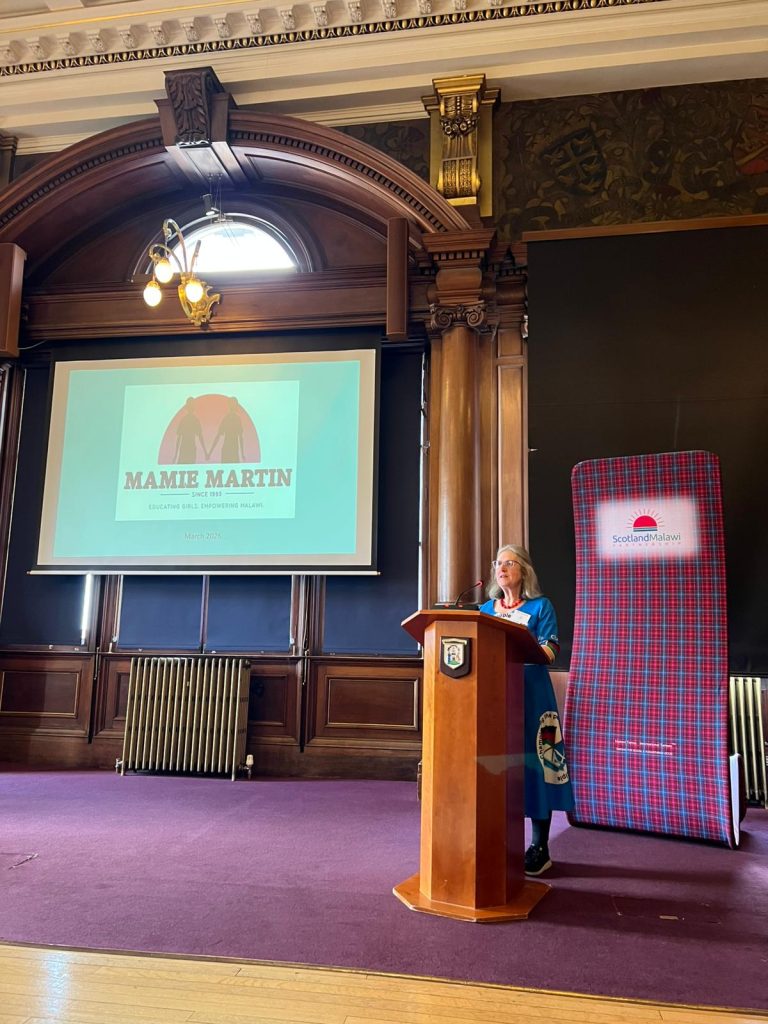
L-R Angie, Moira, Francesca, Nasim and Hon Navicha MPMoira sharing info on MMF’s work in Malawi
The event in Edinburgh was hosted in the City Chambers, an appropriately impressive venue in which to welcome the Minister and her team to the city. Hosted by the Scotland-Malawi Partnership, it was a chance to hear from a range of Scottish organisations working across the areas within the Minister’s portfolio,
Moira, from MMF, shared information about our work and our historic links to Malawi. A video clip of ex-MMF pupil, Stella Dzimbiri, provided powerful evidence of the impact of support at secondary school. The Minister shared the commitment of her government to education for all and to gender equality in particular.
In this same week, Stella’s story has been shared by the Small International Development Charities Network (SIDCN) on their website. They, like so many people, are inspired by Stella’s story and by how huge an impact support at secondary school can make to a woman, a family and a community.
This week, in particular, we send greetings and good wishes to all our ex-pupils and to their teachers too. You are making a real difference in the world.
Following the sudden passing of our colleague and dear friend Alan Laverock, we are looking for a professional individual to join us in the voluntary capacity of Treasurer. This person must have a strong background in accounting, with a clear understanding of charity regulations in Scotland.
We work mostly online, with Trustees and other volunteers based in Scotland, Malawi and other parts of the world! Board meetings take place every two months and are hosted online, with our wider AGM taking place in November.
Needless to say, we can only consider people who share our values and commitment to girls’ education. You must have a UK postal address – due to our bank’s regulations.
The Scotland-Malawi and the Malawi-Scotland Partnerships are celebrating their 20 year anniversary. We congratulate them on the wonderful work done in supporting links between the two countries. As part of the celebration they have published a book which records some of the achievements of the Partnerships and their members.
Photocredit: Kirsty Stroma Photography
We are proud to be included in this book – in the Education section. We provided evidence of the impact of our work in the North of Malawi. We shared a powerful quote from a Head Teacher in a school we support,
“We know that if girls get their education, they will be able to be independent. As a result, this cycle of poverty will be broken.”
We also shared the inspiring story of a woman whom we supported as a school pupil. Stella said “I will ensure that my children get educated.”
Mercy Sibande, our Malawi Country Director, is quoted too and her powerful comment was:
“Secondary school has allowed them to critically think and at least make some changes in the way they deal with situations. Without it they would just have been that uneducated girl at the village.”
We benefit hugely, and have done for many years, from the advice and support of the Scotland-Malawi Partnership, as do all of their members. We look forward to continuing our collaboration in the years and decades to come.
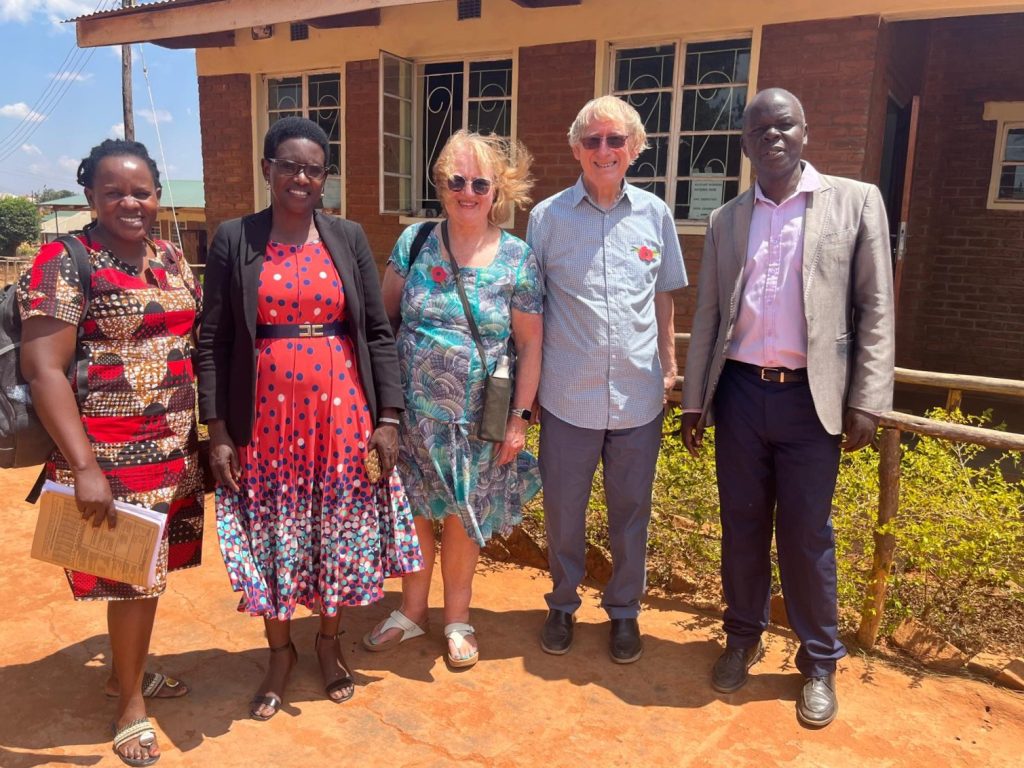
Emyln and Ann Evans lived in Malawi for 3 years in the 1970s. Emlyn worked for Malawi Railways. They revisited Malawi recently. They share their thoughts about that visit.
L-R: Mercy Sibande, Joana Chimphepo, Ann, Emlyn, Dickens Msukwa at MCDSS
“We lived in Limbe, Southern Malawi, in the 1970s. We were close friends of Jack and Phyllis Thomson, and around 13 years ago we asked them to recommend a Malawi charity we could support – they came up with The Mamie Martin Fund, and we have supported the Fund ever since.
After much dithering, we at last decided it was time to re-visit Malawi. So … in October/November this year we visited Mzuzu, Lilongwe and Blantyre. With the wonderful help of Moira, Mercy and Gregory [Mercy’s husband], we were able to visit two schools in the North in order to see at first hand the impact of the Mamie Martin Fund on girls’ education. We saw far more of real Malawi in those weeks than we ever did in the 3 years we lived there in the 70s. We were part of an ‘expatriate’ community back then.
Kwezy buses eventually delivered us to Mzuzu and so we firstly went to see Mchengautuba Community Day School, in a poor suburb of Mzuzu. We were warmly greeted by the Head, Mr Dickens Msukwa, and Mrs Joana Chimphepo, who looks after the MMF girls there. They explained the many challenges the school faces, these include oversubscription and finding funds to complete the building of the much-needed hall. They then arranged a very lively Q & A session with the MMF girls. Then two of the liveliest girls suddenly said “Right – would you like to see around the school?” Linda and Grace then gave us the full belt and whistles tour – we left humbled by such a wonderful welcome, and having seen with our own eyes the result of MMF funding.
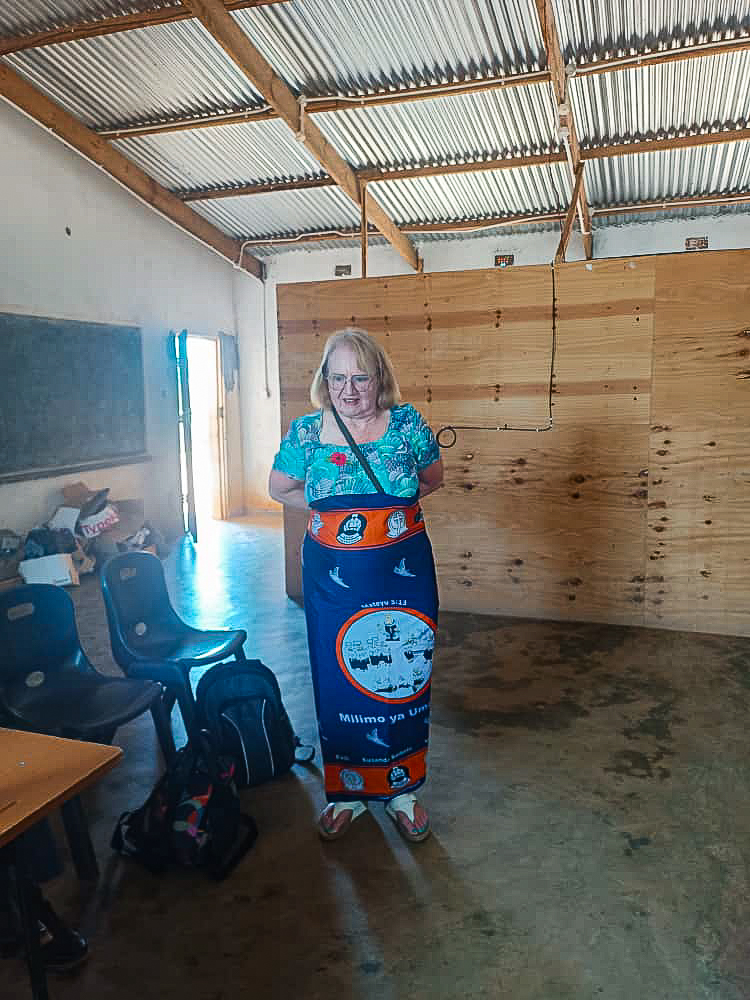
Ann was also overwhelmed by the generous gift of a wrap (chitenje), when the school has so little compared to schools in the UK.
The following day, with Mercy, we visited Bandawe Girls’ Secondary School, near the Lake. Again we were shown every consideration, and warmly welcomed by Mrs Rachel Msumba, the English teacher. We discussed the challenges the school faces, and then had another lively Q and A session with the MMF girls – one question was – “ In Malawi our main activity is agriculture – what is the main activity in UK?” Great question … well, what is our main activity? Having stumbled through an answer to that, we had to explain a free Health service to these pupils.
We again left, humbled by the dedication and hard work of all the staff. At both schools we witnessed the wonderful work Mercy is doing mentoring and supporting the girls, whatever their needs.
Later that day we visited the nearby graves of Mamie Martin and her baby – an immensely moving experience.
We are so grateful to Moira, Mercy and Gregory, and all the staff we met for arranging such enlightening experiences. We were able to see clearly what the Mamie Martin Fund is achieving. We thank all at MMF for giving us this opportunity.
(Our visit did coincide with a severe petrol shortage, but we still managed to move around.)”
We mourn the untimely passing of Alan Laverock, MMF Trustee, Treasurer, Co-Convenor and friend.
Alan volunteered his time and skills to be the MMF Treasurer in 2020. We were delighted to have this new Trustee with his accounting expertise and his deep knowledge of Malawi.
Since then, Alan has been a key member of our governance team. He kept our books straight (so essential) and provided essential advice and guidance on matters of accounting and management. He was generous, too, in the sharing of his knowledge and understanding of Malawi. His regular visits to and long stays in Malawi were greatly to our advantage. He represented us superbly well and gave moral and practical support to Mercy Sibande, our Country Director. Mercy said of him
“It is a great loss indeed. Alan will be missed greatly, his works were to improve the livehoods of many in Malawi. May his soul rest in peace. Will miss his support for the schools visit.”
The Scotland Malawi Partnership have written a full tribute to Alan. We cannot do better by him than to direct our readers to it – here.
As new school years have started in many parts of the world, on October 5th , World Teachers’ Day, it’s time to celebrate teachers everywhere. This year for the first time UNESCO will mark World Teachers’ Day in Africa, during the Pan-African Conference on Teacher Education in Addis Ababa, Ethiopia. This event ties in with the launch of a new Continental Education Strategy for Africa (CESA) and the African Decade for Education which aim to prioritize education and the teaching profession, recognising their importance in helping to advance Sustainable Development Goal 4, quality education.
By Janet Sinclair, teacher
The idea for the Mamie Martin Fund was inspired by the memory of a teacher, Mamie, who although she arrived in Malawi (Nyasaland) in 1921 as a missionary’s wife, immediately felt drawn to supporting and teaching the local girls who faced many barriers and had few opportunities to continue their education. Once a teacher always a teacher!
This mission is still at the heart of our work today and MMF is proud to have been able to support more than 700 girls in secondary education in Northern Malawi since 1993. The theme of this year’s Teachers’ Day is collaboration, and without the collaboration of the teachers whose hard work and commitment are integral to helping Malawian girls to achieve their dreams, MMF’s work would be impossible. So, on this day we would like to recognise the invaluable work of these teachers and thank them for their contribution.
“Teachers empower students with skills and knowledge that can help them find better job opportunities and improve their standard of living here in Malawi.” (Stellah Banda, student teacher)
“The greatest untapped resource in the developing world is not oil, gold or rare earth minerals; it is village girls who often are held back from school, married as children and expected to spend their lives fetching water and caring for others. Talent is universal, even if opportunity is not.” (Nicholas Kristof, New York Times, Oct 1st 2025)
8 September is International Literacy Day, a cause that is very close to the heart and work of the Mamie Martin Fund. From our roots in the 1920s when Mamie Martin became aware of the barriers facing girls in education to 32 years later, when we are now able to support 163 girls across 7 schools, we work to improve equal access to secondary education in North Malawi.
Improved literacy and life-long learning, particularly for girls and women, is part of the 2030 Sustainable Development Goals. Globally girls and women are disadvantaged due to gender inequality, cultural expectations, family responsibilities, child marriage, living far away from schools and lack of sanitary provisions. This is certainly the case in Malawi.
Reducing gender inequalities through education empowers girls and women and has a real impact on their life outcomes by enabling them to participate in the work force and improve their family’s economic situation, nutrition and health. Literacy for women helps to break the cycle of poverty and they can become role models for their communities. Educated women are more likely to pass on the benefits of their life skills and ensure their own children complete their education.
Reflecting on the impact of the work of MMF Mercy Sibande, our Malawi Country Director, says
“Secondary school has allowed girls to critically think and at least make some changes in the way they deal with situations ..without it they would just have been that uneducated girl at the village.”
Guest blog post by Malawian student, Patricia Kaunda, who is studying towards a Bachelor’s Degree in Development Studies at the Catholic University of Malawi.
Girls in Malawi face numerous challenges in accessing education, from financial constraints to cultural expectations, and I believe raising awareness can help drive meaningful change.
Patricia Kaunda, Malawian student and guest blogger
Girl-child education is very important in Malawi because it empowers girls to become independent and make informed decisions about their lives. When a girl is educated, she is more likely to delay marriage, get better job opportunities, and contribute positively to her family and community. Educated girls are also better equipped to raise healthier families and break the cycle of poverty. Education gives girls the voice and confidence to stand up for their rights and become leaders in society.
However, many girls in Malawi still face serious barriers in accessing education. One of the major challenges is forced marriage due to early pregnancy. Many girls come from poor backgrounds and may engage in relationships with older men to get financial support. These men may offer them food, clothes, or money, which leads to early sexual activity and unplanned pregnancies. Once a girl becomes pregnant, she is usually forced to drop out of school and may be married off, ending her education permanently. This cycle continues to trap many girls in poverty and dependence.
Cultural beliefs and traditional gender roles also act as barriers. In some families, girls are expected to stay home and help with household chores, while boys are encouraged to go to school. Some parents believe that investing in a boy’s education is more valuable because he will support the family in the future, while a girl is expected to marry and join another family. These outdated beliefs keep girls behind.
Girls are often in more need than boys when it comes to education support. This is because they face more challenges both at home and in school. At home, they are expected to cook, clean, and care for younger siblings before or after school. At school, they may face harassment, lack of sanitary facilities, or embarrassment during their monthly periods, which leads to absenteeism. Unlike boys, girls often lack a safe and supportive learning environment.
Educating girls in Malawi is a key to national development. We must work together to remove the barriers they face and create equal opportunities for both girls and boys. Every girl deserves the chance to learn, grow, and become the best version of herself.
Patricia writes this about herself:
I grew up in Mzuzu City, which is located in the Northern Region of Malawi. I come from a family of three children and I am the second born. My parents have always placed a strong emphasis on education. They ensured that we had all the resources we needed to succeed academically and consistently encouraged us to work hard. I remember when I was preparing for my MSCE exams, my mother relieved me of all house chores so I could fully concentrate on my studies. Even now, as a university student, my parents continue to support me by ensuring I’m accommodated on campus for my safety and convenience. I attended Multicareer Secondary Schools, where I laid the foundation for my academic journey.
This week is National Volunteers’ Week in the UK. We thank our many volunteers for their time and energy. Our small charity runs on volunteer time – from Trustees, to admins, to marketing, to fundraisers. Our only paid staff is in Malawi.
Our non-Trustee volunteers keep things going behind the scenes. Many of the Trustees take on extra tasks such as marketing (thanks to Francesca in particular). Volunteers James and Janet do the invisible but vital work of proofing and checking communications before we send them out to the mailing list.
We always have room for new volunteers, especially in the fundraising and marketing areas. Even just writing us a guest blog post would be great. Watch out for one from Malawi next week.
We are honoured and grateful to be one of the four charities to be supported by Women for Mission this coming year. Women for Mission is part of the Free Church of Scotland. We were delighted to meet many of their members, from all around Scotland, at their annual get-together on 17th May. Mariot, Moira and Francesca represented the Mamie Martin Fund and were made very welcome.
From left to right: Mariot Dallas (MMF), CJ MacDonald (WfM Vice-Chair), Wilma Nicholson (WfM Chair), Francesca Munoz (MMF), Sarah Lytle (SfM Secretary), Moira Dunworth (MMF)
Not only is this an opportunity for us to get extra funding but it is also a chance to share our stories and our purpose with new audiences across the country. The funding from this project will support girls in their final two years at secondary school. This is a challenging stage for many Malawian girls, as the pressures to drop out of school intensify at that point.
As part of the engagement with Women for Mission, we created a video about the Mamie Martin Fund – what we do, why and what impact that work has. This is now on their YouTube channel and is a great way of raising our profile.
We see this new development as an opportunity for real partnership and look forward to meeting church groups around Scotland. Meanwhile enjoy the video about MMF which Catriona Logan of Women for Mission helped us to create:
We use cookies on our website to give you the most relevant experience by remembering your preferences and repeat visits. By clicking “Accept”, you consent to the use of ALL the cookies.
This website uses cookies to improve your experience while you navigate through the website. Out of these, the cookies that are categorized as necessary are stored on your browser as they are essential for the working of basic functionalities of the website. We also use third-party cookies that help us analyze and understand how you use this website. These cookies will be stored in your browser only with your consent. You also have the option to opt-out of these cookies. But opting out of some of these cookies may affect your browsing experience.
Necessary cookies are absolutely essential for the website to function properly. These cookies ensure basic functionalities and security features of the website, anonymously.
Cookie
Duration
Description
cookielawinfo-checbox-analytics
11 months
This cookie is set by GDPR Cookie Consent plugin. The cookie is used to store the user consent for the cookies in the category "Analytics".
cookielawinfo-checbox-functional
11 months
The cookie is set by GDPR cookie consent to record the user consent for the cookies in the category "Functional".
cookielawinfo-checbox-others
11 months
This cookie is set by GDPR Cookie Consent plugin. The cookie is used to store the user consent for the cookies in the category "Other.
cookielawinfo-checkbox-necessary
11 months
This cookie is set by GDPR Cookie Consent plugin. The cookies is used to store the user consent for the cookies in the category "Necessary".
cookielawinfo-checkbox-performance
11 months
This cookie is set by GDPR Cookie Consent plugin. The cookie is used to store the user consent for the cookies in the category "Performance".
viewed_cookie_policy
11 months
The cookie is set by the GDPR Cookie Consent plugin and is used to store whether or not user has consented to the use of cookies. It does not store any personal data.
Functional cookies help to perform certain functionalities like sharing the content of the website on social media platforms, collect feedbacks, and other third-party features.
Performance cookies are used to understand and analyze the key performance indexes of the website which helps in delivering a better user experience for the visitors.
Analytical cookies are used to understand how visitors interact with the website. These cookies help provide information on metrics the number of visitors, bounce rate, traffic source, etc.
Advertisement cookies are used to provide visitors with relevant ads and marketing campaigns. These cookies track visitors across websites and collect information to provide customized ads.