Hannah was an MMF beneficiary at Elangeni Secondary School from 2011 to 2015. Her parents had divorced, her father remarried with new responsibilities and Hannah’s mother could not afford her school fees. The school put Hannah on the MMF list and, with her worries gone, she worked hard and obtained excellent results in her Malawi School Certificate of Education (MSCE).
Hannah with her Certificate of Achievement
Hannah now is in her final year at the University of Malawi studying BSc in accounting with sponsorship from the Soko Fund. She has dreamed of working as an accountant since she was in Level 5 in primary school. She has always loved solving financial issues and therefore, thinks accounting and she are perfectly suited for one another. She believes that her career will shape her to have wide knowledge in fund management which will be a tool that she will use in giving skills to young Malawian women on how to manage their finances in setting up small scale businesses that would allow them to do their own thing rather than depend on government for employment.
Both MMF and Soko are so proud to learn that Hannah has been awarded a Certificate of Achievement for “outstanding performance in academic excellence” in the 2021 round of ‘Best Student Awards’ made annually by TotalEnergies Malawi, a major company focusing on sustainable energy.
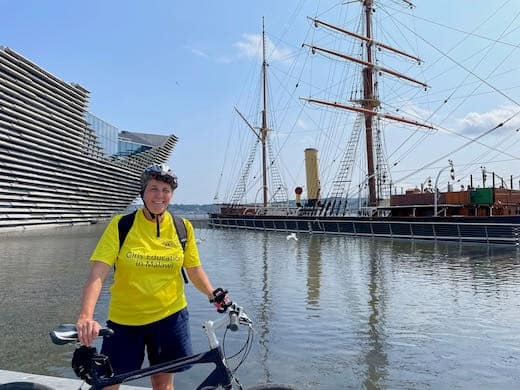
Bike2Malawi rider, Brian Kerr is Chair of the Soko Fund and a Trustee of the Mamie Martin Fund. He has a new e-bike and was keen to give it an outing. He also wanted to see the newly-refurbished David Livingstone Birthplace which reopened on 28th July. Closed for four years to undergo major refurbishment, the new museum exhibition re-introduces us to David Livingstone, focusing more than has been previously done on those around him. He was not really the ‘lone explorer’ of the previous versions of that history.
So Brian set off in the sunshine from Edinburgh to Blantyre. He recalls: “The sun was much too bright for a decent picture (by me anyway). It was a lovely ride-such an interesting variety of countryside and old industrial stuff and the West Lothian mining villages.
Some of the traffic on the roadside paths was not nice – but the canal beyond Coatbridge – you could imagine yourself in La France profonde!! (until the path comes to an abrupt end and you are lost of course!!).
Dr. Livingstone, who WALKED from his home here in Blantyre to Africa – apart from the sea, obviously – is still revered by many in Malawi. On the day I visited the cafe was only open until 3 pm – imagine my feelings arriving on a very hot day at 2.59. Staff were exceptionally kind to an old man!”
Last year’s MMF biking project, Story on Bikes, was launched at the Centre, even though it was still closed at the time. On #Bike2Malawi we stopped off at Mary Livingstone’s grave – Dr Livingstone’s wife. So we feel a strong bond with this Centre and are glad that Brian made it there and back (just) on the battery of the new e-bike. He has in mind to visit Dunluce Castle in Ireland; Mamie and Jack Martin sailed to Africa in its namesake in 1921. So watch this space for his report on that trip.
“As a now semi-retired Gynaecologist, I was very privileged, in 2016, to travel to Nkhoma Hospital in Malawi with the Scotland-Malawi team to contribute in a small way to their phenomenal programme of cervical screening and cervical cancer prevention. We have helped to introduce practical but effective treatment of pre-cancer, as originally pioneered by my predecessor, Dr Ian Duncan, in Dundee. I was bowled over by the camaraderie, dedication and expertise of the local Malawian teams who continue to work so effectively under such challenging conditions.
Since my return we have all continued to ‘virtually’ support work in Malawi and worldwide as much as possible but clearly any plans for return visits to that wonderful country have now been deferred and overshadowed by the COVID pandemic.
Meanwhile it is heartbreaking to hear of increasing numbers of young girls now obliged to leave school due to the economic effects of the pandemic. These young girls then become teenage brides and mothers, thus repeating the cycle of inequity. If we are ever going to work our way towards a fairer world, we have to educate girls and young women. Educating girls allows them to make safe choices about their own reproductive health and, in time, that of their children and families. It also allows them to become financially independent and enter the workforce as the hundreds of nurses, teachers, doctors & scientists Malawians need to become equal partners in delivering anywhere near the standards of health care that we in the UK take for granted
I therefore jumped at the chance with #Bike2Malawi to jump on my bike and raise funds for secondary education in Malawi. We have to keep girls in school, and it is something practical I can do to help whilst constrained to the UK. So far, I have cycled almost 300 of my 350 mile target.
I won’t lie – it has been tougher than I thought – 5-6 miles a day sounds fine until you inevitably miss a day then have to do 12…. Then 18…. And I have been on holiday for 3 of the 9 weeks of the fundraiser (not always with a bike) so have had to do some mammoth rides to catch up. We are so lucky though to have such wonderful scenery to cycle through both here in Scotland and across the UK. I have been joined on my rides by both daughters and various friends and family, so it has been good exercise and good fun. I am truly humbled by the response of my family, friends and colleagues to my fund-raising efforts, which I know reflects their understanding of how much this all means to me. Good luck to all those cycling the 10,679 miles and I hope we all meet in person one day. Thank you to the Mamie Martin Fund for making this possible and to all those doing the groundwork to facilitate this fundraising; it is an incredible effort all round.”
Continuing our series of posts by Bike2Malawi riders, Violet Hejazi writes:
“I am a law student who is also a former refugee. I come from Syria, and I am one of the riders of the #Bike2Malawi team organised by the Mamie Martin Fund in support of girls’ education in Malawi.
After a long time spent at home in lockdown doing things I had to do, it was finally the time to do the thing I chose to do!
On a sunny, non-lockdown day, and along with very cool friends and for a great cause, I cycled by the coast of Lancaster and had the best chips in Morecambe. We took some photos and ate some cake.
I found a jasmine tree that filled my heart with joy and made me feel at home. We said hello to the wee kid on his tiny bicycle as we pushed our pedals to raise money to help girls in Malawi pursue their education and secure a decent future for themselves and their families. Going up and down semi-hills, which to me felt like proper steep hills, I was reminded of the struggles that young girls in Malawi face daily and the significance of making education accessible and obtainable for them. I reflected on my childhood and, despite all of the obstacles, how lucky I was in having had the opportunity to be in school and not worry about accessing education.
I am taking part in cycling 100 miles to raise awareness and fund this project, hoping that one day no child will be deprived of their right to be educated and can grow up to become independent, successful members of society.
This was the first 16.5 miles of the 100 miles I will be cycling over the summer, which I am very excited to complete and share stories about!”
My name is Maeve Rafferty and I am very excited to be working with the Mamie Martin Fund to conduct research for my dissertation looking at how MMF-supported women navigate their careers, tertiary education, and sexual and reproductive health after graduating from secondary school. I am an MSc student in Africa and International Development at the University of Edinburgh.
My interest in international development stems from a desire to see equal opportunities afforded to everyone worldwide regardless of their background and characteristics. Specifically, I am interested in how sustainable development can be achieved in East and Southern Africa through political-economy means. On a macro-level I enjoy exploring what this means for governance both on the continent and internationally. From a more micro-perspective I am particularly interested in the intersectionalities of development with gender, displacement and business. Since completing my BA in Business and Political Science at Trinity College I have worked in development firstly, with GOAL as a Development Education Officer in Dublin and latterly, with Viatores Christi as a Project Support Officer in Kampala and, post-Covid, remotely in Dublin.
We are already four months into our Mamie Martin Fund #Pledge100, celebrating the centenary of Jack and Mamie’s marriage and the start of their time in Malawi. We now have over 30 global pledgers, who have embarked on a wonderful range of active and creative endeavours to help raise awareness of the work done by Mamie Martin Fund.
Some of our creative pledgers have already completed their challenge and have received their very special certificate of completion. Jan, who is based in Sweden, has completed 100 beautiful black and white drawings, and has even embarked on her second challenge. Elizabeth has embroidered 100 lovely, intricate cards which sold out almost immediately! You can see her beautiful designs here. The proceeds from the sale of these cards have added a real boost to our #Pledge100 fund-raising efforts –so a huge thank you to Elizabeth for her creative contribution and to everyone who was quick enough to buy her cards!
Jean is swimming 100 swims for Mamie Martin Fund’s #Pledge100
Our #Pledge100 awareness raising and fundraising efforts have been so successful that we have already reached and passed our fundraising target. That calls for a huge thank you to all our pledgers and everyone who has contributed. Let’s not stop here! We still have eight action-packed months to go, so let’s set our sights higher. This is really challenging time in Malawi, with disruptions to education caused by Covid-19. Fundraising for the Mamie Martin Fund means that we can continue to help girls return to school and complete their secondary education.
Here is Kate Jere making the case for helping get girls back to school: “As schools re-open again in Malawi following COVD-19 closures, ensuring girls get back to school has never been more important. Lessons from the Ebola crisis in West Africa have shown that extended school closures increase girls’ risk of early and unintended pregnancies, and result in permanent exit from education.”
Mamie Martin Fund provides an important safety net for girls from disadvantaged backgrounds, providing vital support with school costs, transport and other necessities –greatly increasing their chances of staying in school and completing their education.It’s easy to join #Pledge100.Just find something you can pledge to do 100 times during the remainder of 2021 and register here.
We would love to have you on board! All sponsorships and donations are also welcome here.
The Kiltwalk went virtual again this Spring. People could choose their own challenge and complete it over the weekend 23 – 25 April. Michelle only learned about the Kiltwalk the week before. When she had checked that she had not misheard (‘so you wear some tartan and walk?’), she went for it, aiming to walk 20 miles around Edinburgh on Saturday 24th. She plotted a route which included Arthur’s Seat, Water of Leith and Cramond and set off from Newhaven.
Her preparation including buying some tartan; if she was to be a kiltwalker, there had to be tartan. She excelled herself in a few days, with tartan leggings and a skirt. Teamed up with an MMF tee-shirt and some Malawi-Scotland chitenjie, she was the picture of a true kiltwalker.
Supported by her sister Heidi and Moira from MMF, both on bikes, Michelle set a pace of 18 minutes a mile and she held that pace all day. We had a few rest and food stops and the occasional ‘tourist’ stop. The team met some other kiltwalkers but not as many as expected.
It was a lovely sunny day but there was a vicious North-Easterly wind which felt hard walking by the sea from Cramond to Granton. However, at Granton, hot tea and home baking was provided by an MMF friend and Michelle turned to the last few miles with renewed energy. It was after the home baking that she decided to go for the full marathon distance of 26.2 miles and she completed 26.3 miles on Newhaven pier as the sun went down. What an achievement!
In the meantime friends and family donated to her fund-raising page. All donations will be topped up by 50% this year by the Tom Hunter Foundation, so Michelle is, at the time of writing, well on the way to raising enough money to support two girls at boarding school in Malawi for a whole year. Double-achievement. Thanks Michelle!
Mamie Martin Fund volunteer, Richard Robinson, has been thinking about decolonisation from the perspective of organisations like ours. He has published his thoughts on Medium and we share some snippets here and encourage you to read the whole piece.
“In the light of recent debate in the UK I have been thinking about the past links between Scotland and Africa, about how we frame them now, and what that should mean for the future
…
For many of us our own education and cultural background mean that our ways of thinking and unconscious attitudes carry vestiges of colonialism. We must inspect what we do and how we do it to ensure we compensate as well as we can. We should do this openly, which will offer opportunities to make our contribution more visible in Scotland and more effective in Malawi. We strive for our work and our relationships to be conducted in the spirit of respectful partnership but there is no fixed standard for this. It will always be a progressive process in which MMF must be clear about its rôle.
There is still a power imbalance between Scotland and Malawi, particularly stark in wealth and social capital, and this is partly a result of extractive colonialisation. But poring over the balance sheets of a century ago is less helpful than looking at what is happening today: Malawi is still suffering economic disadvantage from global taxation and trade regimes.
…
The MMF website already has great stories from girls and women whose education has been supported. It could also play a part in seeking out, promoting, and publishing personal evidence about colonialism.
For readers who haven’t heard of the Mamie Martin Fund before, please investigate! Allowing girls full access to education, and empowering women, is work that is not even finished in Scotland. In Malawi it has huge potential to contribute to economic well-being and quality of life, and I will soon be out on my bike helping to play whatever small part I can.”
In the Preface to Spirit of Malawi, Susan Dalgety states her ‘ambition [was] to write a book that captured the essence of contemporary Malawi through the stories of its people.’ She achieves this, and more.
Susan Dalgety, a Scottish journalist and local politician, clearly loves Malawi, which she has visited many times since 2005. She interviewed a wide range of Malawians of different ages and backgrounds, from village chiefs and small farmers to government ministers, from a taxi driver and hospital porter to a fashion designer and social media professional. She writes in a clear accessible style and with a journalist’s eye for a good story.
There are five sections: ‘The cycle of life’ (possibly my favourite section covering birth, health, early and teenage years, adulthood, family life and growing old); ‘All in a day’s work’; ‘The people’s culture’; ‘A young democracy’; and finally ‘Whither Malawi?’ There are several pages of Susan’s own colour photographs, all featuring people at work, school and play.
I didn’t find many gaps. Maybe the book could have covered music and musicians a little more. Music is everywhere in Malawi: from traditional dances and drumming to the creative improvisation of instruments (amateur recordings of musicians who create their own instruments make up the most listened-to programmes on Malawi radio) to the many live bands that do the urban music circuit.
This is an unsentimental book which charts people’s daily frustrations and worries and the curse of corruption that affects most levels of life now. It demonstrates stark inequalities in income, education and life chances, which in some ways are worse now than in the aftermath of colonialism. But it also captures the spirit, hard work and entrepreneurialism of ordinary people, and larger successes, for example in fighting AIDS. Above all, it’s a hopeful book.
I’d recommend this book to anyone looking for an up-to-date understanding of Malawi.
Jean Bareham lives in Edinburgh. She worked in Malawi as a VSO Training Librarian at Chancellor College, Zomba from 1978 – 1980, and has visited several times since, the last as a tourist in 2017.
Today, March 8, is International Women’s Day, a day of celebration of women’s achievements. When working at the University of Malawi, women colleagues and I would leave our workplaces and, along with women all over the country, join together in church services and prayers: a time for singing, dancing, joy and reflection. And Malawi does have much to celebrate. Women are increasingly taking up leadership roles in government, with the first Female Speaker of the National Assembly elected in 2019; young female lawyers were at the forefront of the successful call for fresh elections in 2020, following vote-rigging by the previous government; maternal mortality rates have dropped dramatically and more girls than ever before are in school and learning.
Yet International Women’s Day, with its 2021 theme of #ChoosetoChallenge, also marks a call to action – and much remains to be done in Malawi to achieve gender equality. Although women play an active role in civil society, less than a quarter (23%) of parliamentarians are women. Whilst the constitution and recent legislation protects women’s rights, powerful social norms and customary practices undervalue women and girls and restrict their access to property, financial services and decent work. Women and girls face high levels of violence, and despite a 2017 constitutional amendment raising the age of marriage to 18, rates of child marriage are amongst the highest in the world, at over 40%.
Education, especially for disadvantaged girls, is an important catalyst in progress towards women’s empowerment and a more gender-just society. Keeping girls in school and – providing access to quality, inclusive education – can have powerful multiplier effects. Educated girls and young women not only have greater opportunities to fulfil their own potential, but can be powerful role models in their homes and communities, can challenge expectations for their role in society and make informed decisions about the health of themselves and their families. Recent research from Malawi shows that girls in school are less likely to experience violence and are at lower risk of child marriage and early and unintended pregnancy.
While Malawi has made great improvements in girls’ education over the last two decades, closing gender gaps in basic education, many adolescent girls fail to complete secondary education, dropping out before Form 4 and their national examinations: for every 100 boys in upper secondary, only 68 girls are enrolled. Social pressures compounded by school-related costs impact on girls’ ability to complete their education, with girls from the poorest households at the greatest risk of dropout. And as schools re-open again in Malawi following COVD-19 closures, ensuring girls get back to school has never been more important. Lessons from the Ebola crisis in West Africa have shown that extended school closures increase girls’ risk of early and unintended pregnancies, and result in permanent exit from education.
Mamie Martin Fund provides an important safety net for girls from disadvantaged backgrounds, providing vital support with school costs, transport and other necessities – greatly increasing their chances of staying in school and completing their education. Over 80% of MMF-supported girls have successfully completed their secondary school and gone on to thrive and make important contributions in their own right, like Stella, a frontline nurse; others, with the support of the Soko Fund, like Annie, have gone on to successfully complete a university degree – definitely something worth celebrating!
We use cookies on our website to give you the most relevant experience by remembering your preferences and repeat visits. By clicking “Accept”, you consent to the use of ALL the cookies.
This website uses cookies to improve your experience while you navigate through the website. Out of these, the cookies that are categorized as necessary are stored on your browser as they are essential for the working of basic functionalities of the website. We also use third-party cookies that help us analyze and understand how you use this website. These cookies will be stored in your browser only with your consent. You also have the option to opt-out of these cookies. But opting out of some of these cookies may affect your browsing experience.
Necessary cookies are absolutely essential for the website to function properly. These cookies ensure basic functionalities and security features of the website, anonymously.
Cookie
Duration
Description
cookielawinfo-checbox-analytics
11 months
This cookie is set by GDPR Cookie Consent plugin. The cookie is used to store the user consent for the cookies in the category "Analytics".
cookielawinfo-checbox-functional
11 months
The cookie is set by GDPR cookie consent to record the user consent for the cookies in the category "Functional".
cookielawinfo-checbox-others
11 months
This cookie is set by GDPR Cookie Consent plugin. The cookie is used to store the user consent for the cookies in the category "Other.
cookielawinfo-checkbox-necessary
11 months
This cookie is set by GDPR Cookie Consent plugin. The cookies is used to store the user consent for the cookies in the category "Necessary".
cookielawinfo-checkbox-performance
11 months
This cookie is set by GDPR Cookie Consent plugin. The cookie is used to store the user consent for the cookies in the category "Performance".
viewed_cookie_policy
11 months
The cookie is set by the GDPR Cookie Consent plugin and is used to store whether or not user has consented to the use of cookies. It does not store any personal data.
Functional cookies help to perform certain functionalities like sharing the content of the website on social media platforms, collect feedbacks, and other third-party features.
Performance cookies are used to understand and analyze the key performance indexes of the website which helps in delivering a better user experience for the visitors.
Analytical cookies are used to understand how visitors interact with the website. These cookies help provide information on metrics the number of visitors, bounce rate, traffic source, etc.
Advertisement cookies are used to provide visitors with relevant ads and marketing campaigns. These cookies track visitors across websites and collect information to provide customized ads.