< Girls Education Archives – Page 7 of 8 – Mamie Martin Fund

International Women’s Day 2021

Dr Kate Jere, a Trustee of MMF, writes: 

Today, March 8, is International Women’s Day, a day of celebration of women’s achievements. When working at the University of Malawi, women colleagues and I would leave our workplaces and, along with women all over the country, join together in church services and prayers: a time for singing, dancing, joy and reflection. And Malawi does have much to celebrate. Women are increasingly taking up leadership roles in government, with the first Female Speaker of the National Assembly elected in 2019; young female lawyers were at the forefront of the successful call for fresh elections in 2020, following vote-rigging by the previous government; maternal mortality rates have dropped dramatically and more girls than ever before are in school and learning.

Yet International Women’s Day, with its 2021 theme of #ChoosetoChallenge, also marks a call to action – and much remains to be done in Malawi to achieve gender equality. Although women play an active role in civil society, less than a quarter (23%) of parliamentarians are women. Whilst the constitution and recent legislation protects women’s rights, powerful social norms and customary practices undervalue women and girls and restrict their access to property, financial services and decent work. Women and girls face high levels of violence, and despite a 2017 constitutional amendment raising the age of marriage to 18, rates of child marriage are amongst the highest in the world, at over 40%.

Education, especially for disadvantaged girls, is an important catalyst in progress towards women’s empowerment and a more gender-just society. Keeping girls in school and – providing access to quality, inclusive education – can have powerful multiplier effects. Educated girls and young women not only have greater opportunities to fulfil their own potential, but can be powerful role models in their homes and communities, can challenge expectations for their role in society and make informed decisions about the health of themselves and their families. Recent research from Malawi shows that girls in school are less likely to experience violence and are at lower risk of child marriage and early and unintended pregnancy.

While Malawi has made great improvements in girls’ education over the last two decades, closing gender gaps in basic education, many adolescent girls fail to complete secondary education, dropping out before Form 4 and their national examinations: for every 100 boys in upper secondary, only 68 girls are enrolled. Social pressures compounded by school-related costs impact on girls’ ability to complete their education, with girls from the poorest households at the greatest risk of dropout. And as schools re-open again in Malawi following COVD-19 closures, ensuring girls get back to school has never been more important. Lessons from the Ebola crisis in West Africa have shown that extended school closures increase girls’ risk of early and unintended pregnancies, and result in permanent exit from education.

Mamie Martin Fund provides an important safety net for girls from disadvantaged backgrounds, providing vital support with school costs, transport and other necessities – greatly increasing their chances of staying in school and completing their education. Over 80% of MMF-supported girls have successfully completed their secondary school and gone on to thrive and make important contributions in their own right, like Stella, a frontline nurse; others, with the support of the Soko Fund, like Annie, have gone on to successfully complete a university degree – definitely something worth celebrating!

Women and Girls in the Sciences – a view from Malawi

I am Mrs. Fiddes Msowoya, a woman who loves Mathematics and Sciences a lot. All my studies are mathematics / science related with credit overall grades for diploma and degree programmes. Studying Masters in Science Management Studies, I still register beyond undoubted distinctions for each course I pursue. I, therefore, urge all the females to love these fields and challenge the world that women too can do it.

Females are still treated secondary in many African countries where Malawi is not exceptional. There is need to strike a balance such that all females should get equal job opportunities as it is with their male counterparts in such fields. This can be achieved only when they enroll in such courses in order do away with categorizing the two groups. Women are equally capable as men. They are strong intellectually. Hence, it is important for them to learn science based opportunities.

Science jobs are well paying, hence such women role-models too shall be empowered and be well paid.

It is paramount to advocate for more females in sciences because currently the world revolves around Science and Technology, Engineering, Mathematics and innovation .Many existing opportunities require such skills and females are facing challenges in competing at global level because of lack of such skills. Without the involvement of women in sciences, males continue to enjoy exclusive employment in science related fields.

Encouraging females to participate in sciences will increase the pool of human resource from which the country can benefit and that will enhance sustainable development .

In Malawi, female population outweighs that of males and excluding them in sciences ensures delayed socio-economic development.

Women are naturally creative, this presents a great opportunity that can foster innovation and help in bringing about a major breakthrough in solving some of the problems in Malawi as a developing country.

Mrs Fiddes Msowoya
The Director of Education Y outh and Sports
M’mbelwa District Council
Mzimba District

Pledge100 up and running (and cycling and swimming)

Our #Pledge100 project celebrating the centenary of Mamie and Jack Martin’s marriage and journey to begin their new life together in Malawi, was launched in early January and now almost a month later is very definitely up and running.

We already have 13 pledgers (with several more in the pipeline) from places as far flung as North America, Hungary, Portugal, Berkshire, Falkirk, Glasgow and the Scottish Highlands. The idea is that people pledge to do 100 of something they enjoy in 2021 and we have a great range so far: cycling with selfies, open water swims (in the North Sea!), running 5ks, walking (on different continents), doing yoga, taking photos, making cakes and beautiful cards and cheering us all up by sharing 100 Top Tunes. Some people are completing their pledges alone and some in a team. 2021 has just begun so there’s still plenty of time for more people to join in and add their pledges to our eclectic group.

Our pledgers are all fired up with enthusiasm and say that the Pledge100 has helped to get them through a dark January and focus on something positive at this difficult time. All of the pledgers believe passionately in the importance of education for girls and empowering future generations of women in Malawi. Now more than ever these girls need our support to help them complete their secondary education.

Our pledgers have been sharing photos on social media and encouraging other people to join in this celebration or to support our challenges. The more the merrier – we’d welcome your support.

Pledge 100 off to a great start

This being the centenary of Mamie and Jack Martin’s marriage and journey to Malawi, we launched our #Pledge100 project on 1st January. Shona McAllister is our first pledger – she will run a 5k 100 times this year. 

Shona used to run a bit many years ago but took it up seriously during the first lockdown. As part of a virtual running club, a group of six women who motivated each other, she achieved ‘Couch to 5k’ and decided to keep up her running. She says that she could not have done that without the support of those friends. Her ambition was to run well for half an hour. Having achieved that, she is now working on improving her pace. That is a bit tricky in the bad weather so she describes herself as being in ‘maintenance mode’ at the moment.

Shona reminds us that exercise is very good for our mental health. She says that lockdown transformed her lifestyle; she currently works from home and takes a lot more exercise. She and her husband have a new puppy, who is called ‘Emmeline’ after the famous suffragette. No more needs to be said about Shona’s views on girls’ education and her support of our work in Malawi. 

Shona’s connection with the Mamie Martin Fund goes back to her late father, who played in a band with Willie Sinclair, Mamie’s grandson. They held many fundraisers for MMF and Shona thinks of herself as running these 5Ks in her Dad’s memory. 

Shona lives in the southside of Glasgow with Queen’s Park and Linn Park nearby – excellent running opportunities. She hopes that the awareness and money which she is raising by this pledge will support our work with a view to improving equality and girls’ empowerment and reducing rates of child marriage in Malawi; she wants ‘to create a more equal society’. You can support Shona in her pledge or join her by also registering to do 100 of something this year.

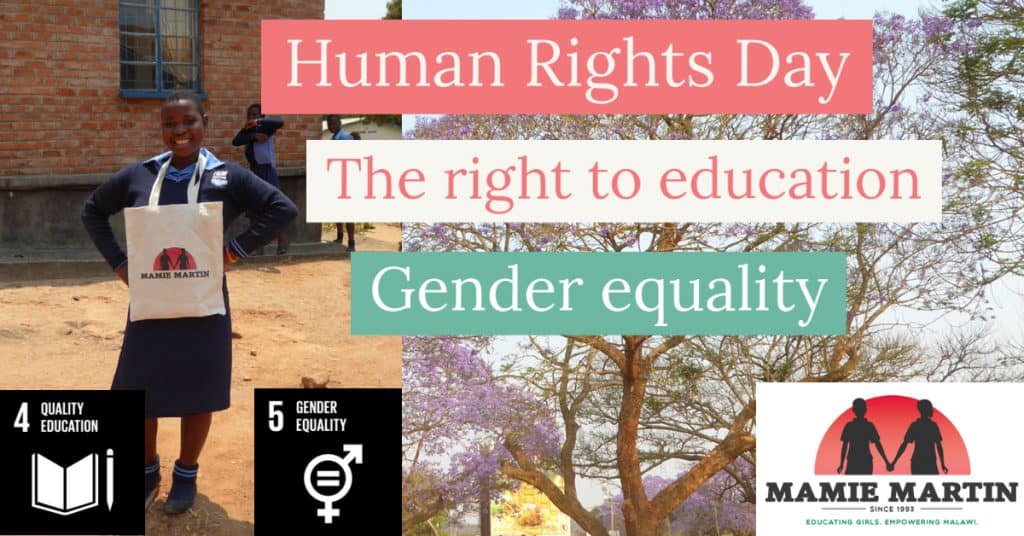
Human Rights Day

Today we mark the UN Human Rights Day. This is the anniversary of the adoption of the Universal Declaration of Human Rights (UDHR): a milestone document proclaiming the inalienable rights which everyone is inherently entitled to as a human being regardless of race, colour, religion, sex, language, political or other opinion, national or social origin, property, birth or other status. We share a few paragraphs from the recent MSc dissertation by Anna Freidenfeld who was on placement with us last summer. She makes some comments about how we might work towards the Global Goal of Gender Equality.

“In order to overcome education barriers rooted in patriarchal norms, wider communities need to be educated on the importance of girls’ education (1). Intersectional ‘gender sensitisation education’ could reduce the marginalisation and discrimination faced by girls – especially those with disabilities, young mothers and orphans of HIV/AIDS – which can push them to drop out of school. Furthermore, NGOs need to employ local women in positions of power to mirror the gender equality they are working towards in the wider world within their own structures (2). NGOs should also focus on helping reduce the cultural reproduction of gender hierarchies within schools (3,4). Accordingly, women need to become more involved in the management of schools. Mothers’ Groups are a good example of community collectives that are increasing women’s involvement in educational management. If NGOs work with local women they can better work towards ‘transformative gender mainstreaming’ in education-policy (5).

The best approaches to overcome education-barriers in Northern Malawi tend to be more holistic, combining multiple tactics and recognising the different education-barriers faced by different individuals. Clearly, the operations of NGOs need to be continually examined so they can work to improve their approaches. Notably, more education-barriers are bound to emerge in wake of the COVID-19 pandemic. Therefore, future ethnographic research in Northern Malawi is needed to provide different perspectives and explore further barriers and enablers to education.”

References:

1 Abane, H. (2004) ‘The girls do not learn hard enough so they cannot do certain types of
work.’ Experiences from an NGO-sponsored gender sensitization workshop in a
Southern Ghanaian community’, Community Development Journal, 39(1), pp. 49–61.

2 Duraiappah, A.K., Roddy, P., & Parry, J. (2005) ‘Have Participatory Approaches Increased Capabilities?’ International Institute for Sustainable Development (IISD) (online). Available at:
https://www.iisd.org/publications/have-participatory-approaches-increased-capabilities 

3 Bourdieu, P. (1973) ‘Cultural reproduction and social reproduction’, pp. 71–112, in Brown,
R. (Ed.). Knowledge, Education and Cultural Change. London: Tavistock.

4 Arnot, M. (2002). Reproducing gender? : essays on educational theory and feminist politics. London: Routledge.

5 Mukhopadhyay, M. (2004) ‘Mainstreaming Gender or “Streaming” Gender Away: Feminists Marooned in the Development Business’, IDS Bulletin, 35(4), pp. 95–103.

Sally makes chitenje masks

Since early summer Sally Evans has been making face coverings for family and friends in exchange for donations to charity. She has made over 300 so far. The demand continues and masks made from African cloth, called chitenje (singular) or zitenje (plural) in Malawi, are particularly sought-after in Scotland.

Sally is a member of St Andrew’s and St George’s West Church in Edinburgh, who have been friends and supporters of the Mamie Martin Fund for many years. She is now accepting donations to the Mamie Martin Fund for her chitenje masks and has set up a page to make it easy for people to donate. 

Sally says, ‘I’m delighted to make some more face coverings to support Mamie Martin’s Back to School in Malawi after Covid fund to address some of the additional challenges in getting female students back to school after such a long interruption. I’ve been given some colourful fabric, normally worn by women in Africa, so will be using this as well as other remnants and recycled material. It’s a WIN WIN situation with fabric from Africa helping to keep us safe and helping to support girls’ education in Malawi!’

We are so grateful for this support and for the good-news aspect of the story. These are challenging times for everyone and Sally is bringing joy and pleasure to so many in her WIN WIN project. Thanks Sally! You can contact Sally directly about this on [email protected] You can also buy these masks at the Undercroft Café at St Andrew’s and St George’s West while our photo exhibition is there from 24th November.

Alloway rebuilds hostel in Bandawe

Many years ago we were able to build a hostel at Bandawe Girls’ Secondary School in Malawi, by the lakeshore. Over the years the hostel fell into disrepair but we had neither the funds nor the management capacity to address this problem. Trustees from Scotland saw the poor state of the hostel on their visits. 

This hostel has now been completely refurbished. This has been funded and managed by Murray Hutchison and friends at Alloway Parish Church in Ayrshire, Scotland. Funds were donated via coffee mornings, Christmas Fayre and by friends of the Church and the school. The total cost was £23k but the impact on the 102 girls who live there in term time will be immense. To quote from the letter written by the Head Teacher, Mr Denis Kamata:

The hostel project has not just provided accommodation to the girls but it has also:

Improved the health of our learners who will be not contracting skin and respiratory diseases that were the order of the day in the past due to the state of the hostel .

Contributed to the enhancement of unity amongst our girls as the feelings of being discriminated against amongst those that were using the other good hostels will no longer be there.

Enhanced the security of our girls and their property because of the nature of the windows with burglar bars, well fitting window panes and doors.

Added significantly to the infrastructure development programme of the school.

Helped our girls to understand that they are not alone in this global village but that there are people far away from Malawi that care and wish them well.

Before work started on the hostel refurbishment

Murray Hutchison’s report gives a flavour of the urgency of these building works: 

There is no doubt that the 102 girls living in this large hostel have had their lives changed for the better: water no longer pours in through holes in the roof and the toilets and showers (while  not what we enjoy) have been totally replaced and replumbed and  refurbished. The walls had to be taken down further than expected and their height extended to improve ventilation. Windows and doors have been replaced, a new roof constructed, repairs to foundations and rendering and a  total replacement of all electrics. 

The relationship between Alloway Parish Church started in 2006 when Ayr Presbytery made their first visit to Bandawe. The Church entered into a partnership with Bandawe mission station and Thipula Church and with BAGSS in 2008. Alloway’s two primary schools are twinned with Bandawe Primary where the Church undertook a smaller but similar hostel project in late 2019. This is Alloway Parish Church’s fourth building project at BAGSS. They focus on education and training in various ways and these building projects are a significant help to the school.

We are grateful to all those involved in this project – to Murray for masterminding the fundraising and overseeing the work, to Mr Chirwa (previous Head Teacher) and Mr Kamata for oversight of the work in Malawi and to the building company, Chumugogo Building Company.

Photo Exhibition Premiere

Thanks to a generous donor, we now have a collection of mounted photographs of life and work in Malawi, with an emphasis on girls’ education of course. We are delighted to be able to show some of these photos for the first time as cafés and other venues reopen. The Wonder Spot café in Stockbridge, Edinburgh has made us very welcome and we love how these photos look in their art space. The photos can be seen by those in the café (take-away only just now) but also from the street. We’ve chosen bright and cheery photos from the collection to add positivity to the street as we all emerge from lockdown.

The selection and editing of the photos was achieved only because of the help of our photographic volunteer, Sue Dumbleton. In an organisation with minimal paid staff, the contribution of volunteers like Sue is essential to creative work like this. 

The week that was – school visits in Malawi

Our Trustees have had a busy week in Malawi. With Mercy, our Malawian manager, they visited three schools. They are not used to setting off before breakfast and working right through till lunch, if they are lucky. ‘Let’s grab a coffee’ is simply not part of the schedule – not until the weekend anyway. Every term Mercy visits each of the schools we support. She always addresses the whole group, encouraging them and ensuring that they know to come to her with any problems.

In the first term Mercy also speaks individually to each of the girls who are newly on an MMF bursary. This is an important interview as it establishes the relationship which will last for all of that girl’s schooling and often beyond.

These are long working days; at one school we had 14 new girls this month and 12 in another school. Mercy also manages our small discretionary fund, out of which she gives money for the small necessities which most of the girls lack. They need soap and notebooks; they often need school uniforms and sometimes shoes or schoolbags.

Angie and Moira took the opportunity to chat to the girls when Mercy was conducting her individual sessions. That is always interesting, humbling, shocking (in terms of the hardship and poverty disclosed) and inspiring – all at the same time.

At one of the schools there are new buildings adjacent to the old school but no seats yet. The girls are used to sitting on the ground as there is no alternative outdoors. However, some of the classes are awaiting desks and chairs and sitting on a concrete floor is not good.

The girls are also eagerly awaiting the new hostel which is due to be built in the next year. The present one is so overcrowded that they need to sleep two to a bed. We look forward to seeing that new accommodation on a future visit. 

Wedding list with a difference

On July 20th this year, one of our long-term regular supporters got married in Scotland. Hope Robertson married Malcolm Fleming on a lovely sunny day in Cramond followed by a reception near Biggar. Their special day brought sunshine to many girls in Malawi because they asked their family and friends to make a donation to the Mamie Martin Fund as a wedding gift. What a generous thing to do! In addition, the groom told the wedding guests about our work as part of his wedding speech. It is great when more and more people hear about our work and the need for it. 

This form of fund-raising is particularly appreciated in Malawi,  where money is central to wedding celebrations. Money is thrown in the air as the guest dance and that money is a vital part of the process of the couple setting up home together. Many of those who get married in the UK are lucky in already having a home, and Hope and Malcolm decided that they did not need any material gifts but would like their happiness to make a difference to girls’ education in Malawi. Their generous family and friends donated more than £2,300.00 – enough to pay for school fees for seven girls for a year. Wow!

If you also wanted to mark a special occasion and invite donations to the Mamie Martin Fund, you could ‘start fundraising’ on our Virgin Money Giving page or on Give as you Live. We’d love to know about your plans so that we can share them with other supporters and friends.

Huge thanks to Hope and Malcolm for this thoughtful and generous contribution to our work supporting girls in Northern Malawi.